The Best Post-Apocalyptic and End of the World Novels
Knowledge is great.
But perhaps having the ability to imagine fictional scenarios is even better. As an event plays out in our lives it can be hard to get to the truth. Even years later we might struggle to put the pieces together. With fiction, however, we don’t need to wait for the event to happen or to try a subsequent analysis. The writer creates the scenario, often unhindered by the boundaries of history, common sense or even the natural laws of biology or physics.
A great writer can create their world, immerse us in it and provide a vision of what could be. Sometimes that’s a vision of hell, sometimes literal heaven on Earth. Either way, we get to live in that world, if only in our heads. It’s a powerful skill the writer possesses and is often underrated. Our chattering classes and literary community tend to promote realist literature over this type of genre fiction.
Others have understood the ability of fiction to stimulate thought and provoke debate. Although I don’t particularly agree with their example, To Kill a Mockingbird has polled higher than the bible as an inspirational book. Albert Camus probably summed it up most succinctly when he said:
Fiction is the lie through which we tell the truth.
That seems self-evident for anyone who has read 1984 and Brave New World.
Without the constraints of reality, the possibilities to play out alternative histories and conceivable futures are unlimited. WWII replayed by Phillip K Dick and Robert Harris with the Nazi’s as victors or Ursula Le Guin’s utopian anarchist community living happily on the moon spring to mind. In each case, the author draws us into a fictional world where we become emotionally attached to the characters and the final outcome despite none of it being real or even possible.
I suspect this is why, as I age, I spend more time than ever in fictional worlds. There’s knowledge to be found there. A different kind of knowledge to that needed for a pub quiz – may be a better word for it would be wisdom. For the wise man there’s truth to be found in the lie that is fiction and amongst the best places to hunt for it is in the disaster and post-apocalyptic genres.
There the physical world is in a state of turmoil, society is failing or has collapsed and daily struggles become a matter of life and death. With that backdrop, we are given access to the participant’s lives, arguably no more scripted than Love Island or Big Brother. We experience human relationships at both their best and worst. We see death, suffering, kindness, and warmth. I suspect every lesson you need to learn in life is to be found within the words of these books.
So here’s a selection of the ones that I found the most satisfying.
I Am Legend – Richard Matheson
Matheson’s 1950’s novel spans a few genres. At its core I Am Legend is a vampire story, yet its vampires are far removed from the mincing gothic chatterboxes of popular fiction. Think of this as a zombie apocalypse, or post-apocalyptic, novel – albeit with zombies that are fearful of garlic and killed when staked through the heart.
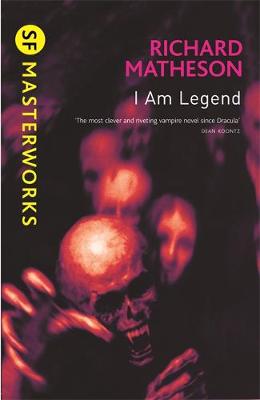
In a world ravaged by a plague that turns both the living and dead into violent, blood-sucking predators, we follow survivor Robert Neville. Trapped in his suburban home he’s nightly harassed by the living dead as they scratch and bang on his house looking for an entrance. With his music turned up, Neville drinks himself into a stupor each evening as he attempts to tune out the taunts and sexual offers made by the vampires. During the day, as they sleep, he scours his community for the infected, dispatching them with a stake before burning the corpses on a funeral pyre.
It’s a lonely and grim existence made bearable only by Neville’s research into the disease, and his belief that a cure can be found. There’s also warmth when, without any human contact in years, he befriends a stray dog. The loneliness is slightly abated as he takes his new companion out with him each day, providing a little respite for the reader.
The story then gathers pace when he meets a woman. A woman who doesn’t behave like the blood junkies hammering at his door, but who may yet prove to be infected. His first real human interaction in years naturally leads to him giving her the benefit of the doubt.
Don’t make the mistake of skipping this one because you’re not interested in vampire fiction. This is a dark, end of the world tale that builds towards a final clash of cultures and competing philosophies.

Earth Abides – George R. Stewart
In 1953 British publisher Sidgwick & Jackson launched the Science Fiction Bookclub and continued releasing titles in the series until 1982. They launched the series with American author George R Stewart’s Earth Abides, released in the states only a few years earlier. Set in California in the early 1940s this is an interesting tale told in three distinct parts. The collapse, 22 years later, and then the central character Ishwerwood’s final years.
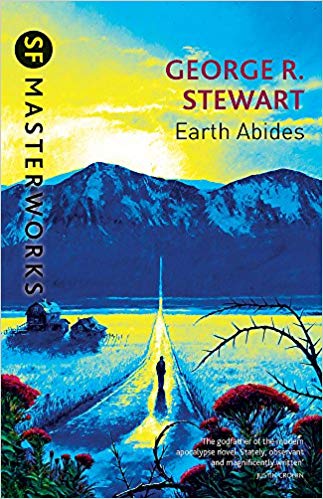
What I enjoyed so much about this book was the pacing. It begins quickly as Ish spends a couple of weeks in a remote cabin recuperating from a snake bite, only to discover on his return that society has completely collapsed. Wiped out by a form of measles.
What immediately follows is a road-trip of sorts as he travels around America interacting with small bands of survivors, before finally deciding that he must help repopulate and rebuild civilization.
Decades later we catch up with Ish and the community that he was instrumental in creating. A social group that in many ways has been a success. They’re well-fed, disciplined and living in traditional family units. But there are worrying signs that become apparent to the ageing Ish. He’s unable to get those who were born decades after the collapse to create and attend schools. Illiteracy is the norm as education is devalued. As a consequence, superstition is rising and some parts of the old life and knowledge are being lost forever. The roads are becoming unusable and ammunition for the guns is failing, making bows and arrows the hunting weapons of choice. No great inconvenience for the younger people who have never lived in a world with cars or gun producing factories.
The collapse of civilization and the initial shock aren’t the point of this book. It’s the attempt to rebuild that Stewart explores. The final section of the book is set during Ish’s late years as he observes the increasingly spartan society of his grand-children.
The Road – Cormac McCarthy
Ask about my favourite writers and I’d not mention McCarthy. Yet I’ve discussed him several times on this blog, and here he is again. Whatsmore, I’ve read The Road more than once. Something I rarely do. Like McCarthy’s other work it’s layered, harsh and has the ability to be deeply moving.
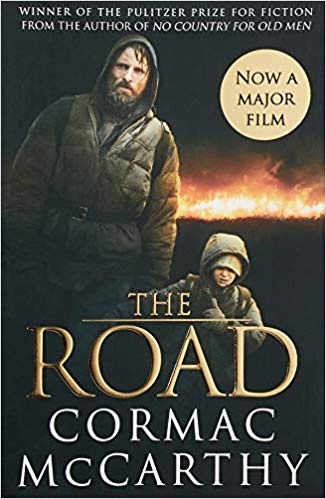
For me the core of this book is simple. It’s about a father and son. The setting is an ash-covered post-apocalyptic world, ravaged by an unknown disaster and almost devoid of life. But that’s just the background. This book explores the relationship between two people. As a father with sons, I loved it and found it profoundly moving.
McCarthy needs no introduction, he’s an established and respected name. Indeed The Road earned him the Pulitzer prize, something I’d venture doesn’t normally go to genre novels. But that’s because The Road is more than another end of the world tale.
It’s recognizably McCarthy, with his sparse prose and in this case, neither of the main characters is mentioned by name. It’s just ‘the boy’ and ‘the man’. Simple, but effective. What need do they have for names in the shell of a world that they inhabit? I was informed by a friend that no female character even gets a speaking part, something I’d not actually noticed. So this is unashamedly a book for men.
The story follows the pair as they trek South looking for better weather. It’s a grim world where bands of marauding cannibals are a constant threat. It’s Mad Max without any of the flair or humour. It’s just one traumatic event after another in an increasingly desperate situation. We’re aware throughout the story that the father is terminally ill and that his desire to head South is in part a last-ditch attempt to find safety for the child. It’s heartbreaking, memorable and a must-read.
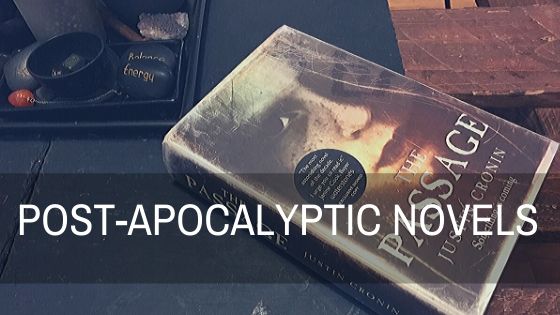
The Passage – Justin Cronin
Unlike some of the other titles on the list, The Passage was a hit when it came out. A New York Times best-seller. It attracted immediate comparisons to The Stand, although that’s not particularly unique among the genre, and like Earth Abides, takes place over the course of a century.
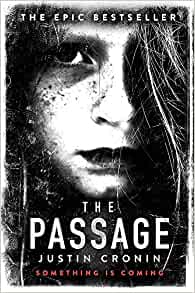
Written in 2010, the book is set in what was at the time the near future – 2016. Initially, we follow the progress of a government experiment to work with a virus originally found in Bolivian bat’s. The test subjects, including a young girl called Amy, end up escaping the facility and ultimately spread the contagion to the point that it destroys civilization. Amy appears well, but others have become a vampire/zombie hybrid. They have increased strength and aggression and an insatiable lust for blood. As the virus spreads, the Earth is rapidly overrun by these hyper-violent vampires.
This opening period of the book was compelling, but for me, it was the second part that was gripping. We pick the story up 93 years after the virus and vampires were unleashed on the world. Society has been destroyed and the narrative moves to a group of survivors living in a fortified community. Under siege, the humans live in constant fear of ‘virals’, some of which may have psychic abilities. Amy turns up at the colony, now aged around fifteen.
This is a substantial novel and like the best of these larger books, the reader is rewarded with a world of epic scope. There’s a destroyed society, a rebuilt community that now seems to be in decline, and quotes from a report that records events 1000 years later. It’s a bold undertaking and for the most part, Cronin has been successful. However, it’s part of a trilogy. I didn’t take to part two at all, but that doesn’t matter. The Passage works just fine as a stand-alone work.
The Postman – David Brin
This was a library find for me. A book that wasn’t on my radar until I picked up a copy on a library shelf and had a closer look. The themes though were familiar. Conflict, contagion, the collapse of society and then ultimately it’s rebuilding. A familiar device within this genre is that the story is centred around a nomadic central character who encounters groups of survivors from the perspective of an outsider.
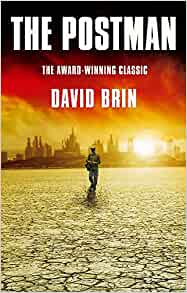
In this instance, the main protagonist is Gordon Krantz. Sheltering in a Postal van after being robbed by bandits, Krantz originally wears a Postal Services garb out of necessity. Having donned the uniform he finds that survivors want to believe he’s a government employee. They want to believe that a rebuilding of America is taking place. Krantz then begins to pass himself off as a representative of the ‘Restored United States’ – all he has to do is receive and deliver mail between the scattered communities. This he does diligently. Trekking between scattered groups, dropping off letters from friends and relatives and taking the next batch away with him.
He begins to see a larger picture and developments not available to the isolated survivors.
Of course, there’s much more to this story than Krantz passing himself off as a Postman, and therefore a symbol of order and stability. Krantz experiences life in a number of communities, some of which are turning into well organised and ideologically inspired armies. So while he’s trying to provide hope and reassurance that the government is rebuilding, in reality, minor dictators are carving out their own fiefdoms and are planning aggressive and deadly expansions.
Like each of the settlements, Krantz has to choose a side. There’s the community lead by an Artificial Intelligence, the hyper-survivalists intent on creating a militarized society, and the Native American inspired Umpqua who have created their own warrior culture. As with Earth Abides, I had the uncomfortable suspicion as I read, that the survivors would never recreate a society the equal of their ancestors.
The Rift – Walter Jon Williams
Williams hasn’t got the high profile of some of the authors on this list. I only discovered him myself when I picked up a cheap copy of his SF novel Metropolitan, a book I thoroughly enjoyed. He’s a versatile writer who appears to have written in several genres, ranging from historical fiction to a Star Wars novel.
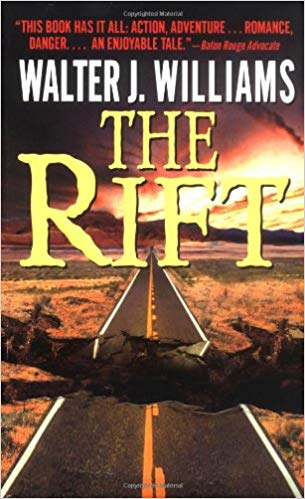
The Rift isn’t strictly a post-apocalyptic title. More a disaster novel, set during and after an earthquake in the US states of Missouri, Mississippi, and Louisiana.
Just shy of 1000 pages this is a bit of an undertaking.
Rather than zombies, vampires or another disease the premise is a little more mundane. A natural disaster that causes destruction, wide-scale flooding, and the threat of a nuclear melt-down. The tale itself is difficult to summarize as there’s a number of stories running in parallel.
The central plot follows a white teenager and a black man as they navigate the Mississippi, sailing around the flooded landscape made dangerous by both nature and human elements. Other strands of the book explore the ideological and political rifts in American society brought into the open by the tectonic rift. There are white supremacists instigating a genocide, religious extremists convinced the end of days is upon them and any number of criminal gangs. But there are also other characters that we follow as they try and stop radioactive waste leaking from power plants and contain the worst of the earthquakes damage.
This is a thoroughly researched and well thought out work that imagines so many of your ‘what ifs’, places them in a very recognizable context and references familiar historical events.
The Death of Grass – John Christopher
Like The Rift, The Death of Grass begins with quite a simple and believable premise. A virus, originating in China, begins killing off the world’s crops. Initially, the West is confident that they’ll not suffer the famines and unrest engulfing Asia, particularly as their governments give assurances that the virus isn’t a threat to wheat, barley and other grasses. However, a mutated version of the virus does take hold in Britain and John Custance learns from his friend that the government have taken the decision to use Nuclear bombs to reduce the population in major cities. Forewarned, the pair take their families and head for John’s brother’s farm in Cumbria.
The bulk of the novel follows their increasingly desperate attempts to reach their destination, with a particular emphasis on the moral compromises needed to survive. The biggest of which occurs when they do reach the farm, now with a large entourage that they’ve acquired along the way. There’s less action than in other similar books, and in parts it’s almost sedate. But that’s very much because it was written not long after the end of WII and addresses the concerns of a writer asking complex moral questions so soon after the end of hostilities.
Swan Song – Robert R. McCammon
Along with Stephen King’s Misery, Swan Song won the 1987 Bram Stoker Award. The two books are at opposite ends of the spectrum of horror writing. King’s is set in essentially one room and features two characters. Swan Song features a vast array of characters in a complex collection of interwoven narratives.
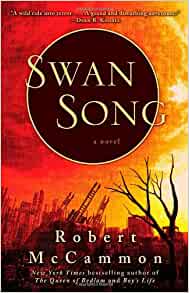
The story follows the aftermath of a nuclear war with the central character being a young girl nick-named Swan. She appears to have special powers, which if realised, could lead to the regeneration of plant life on the dying Earth. A number of times she displays the ability to inspire the growth of plants by her touch. Opposed to this is a shape-shifting being known only as The Man with the Scarlet Eye. His goal is to hunt then kill her. Additional characters include a homeless woman named Sister Creep who is in possession of a mysterious glass ring that is gradually drawing her and others to Swan.
So we have a clear battle between good and evil.
There’s a number of side stories also being told here, amongst them life and conflict in a survivalist bunker in Blue Dome Mountain. It’s equal parts horror, SF and post-apocalypse.
Rivers – Michael Farris Smith
Regular readers will already be aware of my interest in country or rural noir. Combine that with a disaster novel and the result is a book like Rivers. There are similarities to The Rift here. A natural disaster affecting a specific area, a breakdown of society and social norms, and a focus on a small group of survivors.
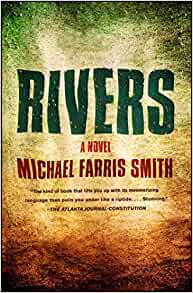
A constant series of hurricanes have left Southern USA devastated to the point that the government have redrawn their borders, thus effectively abandoning the region. Below this line there is no United States. No government, no Police and no electricity. It’s a muddy, wet, lawless landscape.
In this environment we’re introduced to Cohen, living alone after the death of his wife and child. Attacked and robbed by bandits he’s forced to flee his home and ultimately ends up captured by a mad preacher whose band hold a colony of prisoners.
It’s a beautifully written tale where Cohen must balance his own survival against that of the other captives, the roaming gangs and the memories of his family. There are his home and the graves of his family. There are also his fellow captives. However, food, warmth and the promise of a stable society await if he is willing to flee North. Like other books on this list, the real story is about the individual’s place in society and how the civilised man acts when there is no civilisation.
The Stand – Stephen King
Just as dystopian novels are often measured against 1984, so too are post-apocalyptic tales compared to The Stand. It’s one of the biggest tales in the genre, written from one of the biggest authors on the planet.
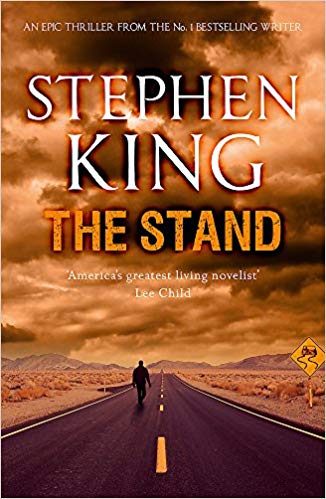
In a sense, that means there are no surprises here. Of the modern End of World novels it laid the foundations. A pandemic, the decimation of the human population, a nightmarish decline into anarchy and an ultimate battle between the forces of good and evil. In its uncut form it’s also King’s largest work.
As expected with King there’s a strong supernatural element as a number of people experience linked dreams involving Mother Abagail, a 108 year old woman. Drawn together, they attempt to rebuild society. In a similar vein to Swan Song, there’s also a competing group, drawn to the ultimate evil. In this case Randal Flagg, a supernatural character who features in a number of King’s books.
The Stand refers to the Mother Abagail’s last stand as Flagg’s troops focus in on the perceived threat of her ‘Free Zone’. Although last on the list, this may be your best place to start if you want an introduction to the genre.