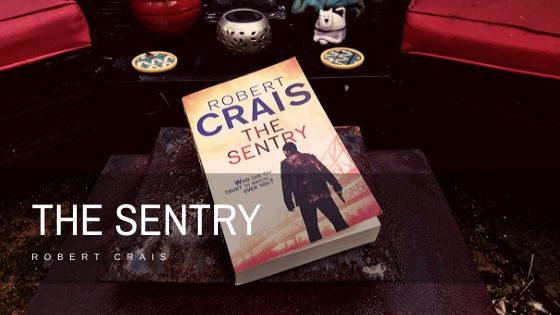
The Sentry – Robert Crais
Most books follow a similar structure. There’s a start, middle and end. Despite the modern tendency to mess with the narrative, by adding multiple narrators and timelines, novels work because they stick to a script.
We recognise specific types of book. There’s the road trip for example. Or the heroes journey. The hero heads off on his quest, wins a battle – often a literal one, then returns home as a new, improved version of himself. In many cases, the story is a stand-alone tale limited to the one novel.
In Lord of the Rings that journey spans three books and in Stephen King’s Dark Tower it’s eight.
Crime books can work with this three-part structure, just a little differently. Each book usually has quite a rigid plot. There’s a crime, an investigation and crucially, a conclusion where the case is solved. So the story is a stand-alone, one-volume book. However, most of the successful authors in the genre produce their work in a series. The same characters solving a different crime each time. In some cases, Sherlock Holmes springs to mind, the same villain may also feature throughout the series. So we get to know the main characters in detail.
John Banville summed it up well.
“With the crime novels, it’s delightful to have protagonists I can revisit in book after book. It’s like having a fictitious family.”
That’s a large part of the appeal of the genre. Like a TV series, we follow the lives of the characters, and with some crime series written over decades, we follow them as if they’re real. We watch them grow and develop.
Take James Lee Burke’s Dave Robicheaux novels. Dave has had three wives in the time I’ve been reading his work, and his once young daughter is now at University. It’s pretty much happened in real-time, with me getting an annual update with each book release. I know they’re not real people, but it’s nice to immerse myself in what Banville called a fictitious family.
But there are not many authors I follow like this. It takes a special author to make this work. They’ve got to be able to make the reader care. It takes a high level of imagination and ability to keep bringing the same characters back repeatedly, to essentially do the same thing, solve a crime, and not bore the reader. Along with Burke, there’s probably only John Connolly and Robert Crais who I’ve checked in with as each new book has appeared.
Crais, a former screenwriter, has managed to keep my attention for a number of reasons. Not only is he a very good writer, but he’s noticeably improved through the series. That’s important to me. It’s felt as if he’s fleshed out the characters and eased back on the hard-boiled, wise-cracking style that featured in his earlier work.
I still refer to these books as the Elvis Cole series, but that’s not strictly correct. Cole is a private eye and ex-Ranger, who fancies himself as both a ladies man and comedian and often refers to himself as the ‘World’s Greatest Detective’. There are echoes of Raymond Chandler in the early books.
However, as the series progresses, his partner Joe Pike plays a larger role. Pike is very much Cole’s opposite, although they do have similarities. Pike is a quiet loner and the owner of a gun shop. A former cop and mercenary who is easily identified by lightning bolt tattoos on each arm. Whereas Cole is cocky and sociable, Pike is an introvert who rarely removes his sunglasses. Pike acts as Cole’s silent partner in their private investigation agency. Together they make a formidable pairing and we follow them on a series of investigations, usually the result of Cole’s tendency to support an underdog.
On Amazon, The Sentry is advertised as the third in the Joe Pike series. I have this down as the fourteenth Elvis Cole novel. But you can see what Crais has done. He’s developed Pike to the point where the secondary character, who it is said was only supposed to feature in a single book, can periodically become the series’ main character.
This case begins quickly and without any scene-setting. We don’t need a world to be built. We already know Pike and Cole, their LA lives and even the cars they drive. Pike, with his heightened situational awareness, spots two gangbangers acting suspiciously outside a restaurant. Intrigued he follows them into the restaurant and intervenes when they beat the restaurant’s owner.
Crais writes the subsequent tale with minimal padding. Pike quickly takes a shine to the restaurant owners niece and offers to help, fearing the gangbangers will return. At first, his assumption is that the attack was nothing more than a small scale shakedown. However, he realises that the FBI has been watching the store and there may be more to the owner and his niece than they have revealed. He quickly has a meeting with a high-level Mexican cartel member and discovers, with the help of Cole, that there are already a number of murders that the feds are connecting to this investigation. Then Dru and her uncle disappear.
With Cole on board, Pike begins to unravel a complex case that began five years earlier in New Orleans following Hurricane Katrina. It becomes immediately apparent that he’s not the only one trying to solve the disappearance. Indeed, it becomes difficult for Cole and Pike to unravel where everyone’s allegiances lie. It’s another cracking read and displays an emotional side to Pike’s personality, albeit hinted at rather than verbalised. There are cameo roles for Cole’s former girl-friend and just enough scenes in Coles hill-side home, that it all feels reassuringly familiar. Another fictitious family that we can catch up with.


