Ham On Rye – Charles Bukowski
Several years ago I worked as a bookseller. Self employed, and having closed my shop, I did a weekly stand at a local flea market. Like all of those places there was a coffee stall manned by a couple of hipsters. Nice coffee in small cups priced like it was nice coffee in large cups.
The guys were friendly, well read, and interested in Beat authors. They were both big Bukowski fans and we chatted a few times about his books. At the time I had a small Bukowski collection. Nothing valuable or rare, but still a nice little run of half a dozen hardbacks with a couple being first editions. As often happens with collectors, tastes change, money is tight, or something else prompts the sale of parts of the collection. I’d grown bored of Bukowski and sold my books to the hipsters.
I recently picked up this copy of Ham on Rye and was immediately intrigued by Roddy Doyle’s introduction. He charted his reading of Bukowski’s work beginning with Post Office and Factotum. The latter was my first experience of the author and a book I thoroughly enjoyed at the time.
Then we both read Women – Bukowski’s semi-autobiographical account of the highs and lows, but mostly lows, of his love life. For me it’s Bukowski’s best work. Grim, humourous and powerful. I’ve recommended it to friends, usually commenting that he makes drunkenness, failure and degeneracy seem so appealing. He manages to sell alcoholism and toxic relationships as a viable and legitimate alternative to a settled family life.
Where as I passed copies to friends, Doyle was so disappointed with the book that it put him off reading Bukowski for a decade. As he states;
“It’s a scrambling mix of selfishness and tenderness, brutality and the blackest humour that makes one want to fling the book away”.
When he did next read Bukowski he picked up Ham on Rye and loved it.
This is where we disagree and in many ways this is central to my own reading of Bukowski. To write this piece I consulted my reading list to see what I’d read by Bukowski and when. It started in 2005 when I read Factotum and continued until 2012 when I read Ham on Rye.
It seems that I’ve already read this book but completely forgotten about it.
More importantly, I read it a second time and I still didn’t notice that none of it was new to me. Like Doyle being put off the author for years by Women, I suspect Ham on Rye must have had the same effect on me.
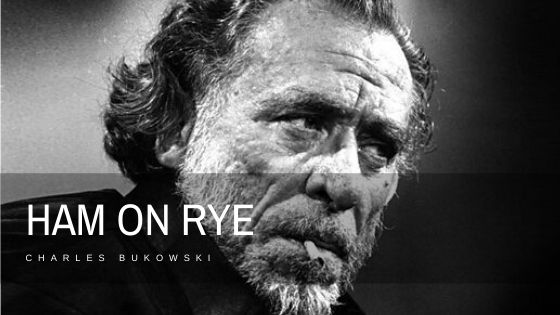
For those unfamiliar with Charles Bukowski, he was born in Germany in 1920 to a German-American father and German mother. As a toddler he moved to America. By 1930 the family had settled in Los Angeles, the city Bukowski was to write about.
He had a difficult childhood and as an adult lived a life of drunkenness and debauchery. He did a series of blue collar jobs, with his stint in the Post Office lasting the longest. His later life was a stark contrast as, with the help of Black Sparrow press, he wrote full time. He would eventually gain a loyal fanbase.
His novels and short stories feature his alter-ego Henry ‘Hank’ Chinaski. They’re autobiographical and many of the characters are based on real people in his life. So when he quit his job in the Post Office his first novel was a fictionalised account of his time there. Women was a chronicle of his relationships with various women over the years, ranging from marriage to one-night stands.
This gets us back to the book in question. Ham on Rye, although written midway through his career, is a retelling of his childhood. A grim time of beatings, bullying and humiliation, compounded by an extreme case of acne. This quote probably sums up the books general tone;
“Maybe I was lacking. It was possible. I often felt inferior. I just wanted to get away from them. But there was no place to go. Suicide? Jesus Christ, just more work. I felt like sleeping for five years but they wouldn’t let me”.
What Bukowski excels at is his ability to find the humour in the grimness of his situation. Like the other books of his I’ve read, I did still occasionally laugh out loud. He creates scenarios where there’s layers of misfortune, most of it self-inflicted. Money is always lost, friendships are always broken and in most cases bottles are smashed and punches are thrown. But he’s woven them into his life, as the norm, so the reader can forget about the specifics and just chuckle at the general madness.
I’ve always thought that Bukowski, with his short, clipped sentences and his recognisable style, could add a charm to scenes that were essentially just drunks bickering. At his best he can sell you that lifestyle. You believe him. The rest of us are the fools who’ve been sold a lie. We’re frauds and he’s honest. He described himself as a stoic, although others often saw more cynicism and nihilism.
But in Ham on Rye I just didn’t quite get it. The bitterness was just too much. Obviously it’s a fictionalised account of his early life, from the opening scene as a toddler playing under the dining room table to his first experience whilst living on his own. But there’s the claim that it is essentially autobiographical. And for the most part it is. That’s a problem because he comes across as too mean spirited for me to empathise with his character. In Women, with the emphasis on the relationship of a man and woman, there are two people involved with mistakes on both sides, and often a genuine attempt to make the relationship work.
Here Chinaski lashes out, literally, at anyone who is around him when he’s drinking. If girls pay his friends attention, then he threatens to hit them. If someone plays a radio too loud he smashes down their door. After a while I felt what Doyle found when he read Women – “what was left was just a list of ugly encounters”.
But there are some great bits. I particularly liked how every loser at school attached themselves to him. Whichever kid is the most likely to get bullied is also the kid mostly likely to ingratiate themselves with Chinaski. There’s a sense that each of the misfits thinks that walking home with Chinaski, the violent misfit, is a form of protection. And in a few cases he does come to their aid.
But there’s other scenes that just don’t ring true. Epic bare knuckle fights with friends, and two scenes where the socially awkward and unattractive Chinaski has older women, in one case his friends mother, wanting to have sex with him. I felt that out of all the things that didn’t really happen in his childhood, this didn’t happen the most.
Ham on Rye is an essential read if you’re interested in Bukowski. How could it not be? It chronicles, through his alter-ego, how the child became a man. But it’s not the best place to start. Try Post Office, Factotum or Women first.