Winter’s Bone – Daniel Woodrell
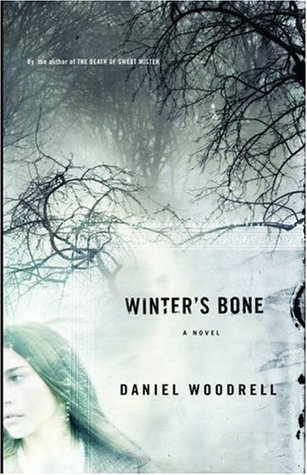
There are very few books that I pick up that I’ve meant to read for a while. As I look at my to-read pile there are a few notable exceptions. Camus’ Outsider is there, as is Kerouac’s classic, On the Road. Both cheap paperbacks that I will get around to, purely on the basis that I know that I should. But for the most part, I pick up books that take my fancy or are novels that fit well with my current interests. Despite popular wisdom, I can reliably judge a book by its cover and often do.
So recently I’ve been on the hunt for rural or country noir. I had James Crumley’s name in my mental notebook and along with William Gay, I’ve managed to pick up his books on my travels. A couple of nice finds in bookshops, flea markets or charity shops.
One author that I’ve been on the lookout for is Daniel Woodrell, the man who coined the term ‘country noir’. He’s a reasonably well-known writer. A multiple award winner, with three of his novels having been adapted as films. Despite this, I’ve not come across any of his books when I’ve been out searching. And really, there was one of his titles that I aimed to read first, Winter’s Bone.
Each time I researched this genre Woodrell’s name was mentioned, with Winter’s Bone featuring on everyone’s list of favorites. So I just needed to find a damn copy. As it turns out my local library was able to order in one and I was spared the indignity of ordering a cheap book online.
So why did Winter’s Bone make it onto the small list of books that I really felt I must read?
There are a couple of reasons. Firstly, as already noted, it’s an accepted classic of the genre. Secondly, Woodrell has such a good reputation that I felt that I had to get around to trying him at some point. Finally, and most importantly, his work brings me full circle.
This recent obsession with dark, rural crime began with The Ozark’s tv-series and once I knew of the genre, Country Noir, I was able to pinpoint exactly what I was looking for. Woodrell was raised in the Ozark’s and sets each of his novels in this, to me, deeply unfamiliar landscape.
The first thing that struck me with Winter’s Bone is that, like Cormac McCarthy, there was a little period of adjustment needed to warm to his style. Not just that, the turn of phrase didn’t initially flow naturally for me. As an Englishman, I had to read a number of the lines more than once to grasp the meaning. The first line of the book gives an immediate sense of his prose style.
“Ree Dolly stood at break of day on her cold front steps and smelled coming flurries and saw meat”.
Like both the weather and the local landscape, the language is bleak and Woodrell is miserly with his descriptions, allowing the simple language to reflect the even more simplistic lives of the characters. As with McCarthy, the more I read in a single session, the more I was rewarded. Ideally, I would have read this short novel in one sitting. The rural accents, the slang, and the style all flowed naturally the more I immersed myself in the story. Equally, the more I immersed myself in the narrative, the grimmer it became.
This wasn’t an easy, or particularly enjoyable, read. Maybe that’s not strictly true. It was enjoyable, in the sense that it was satisfying. But I wouldn’t describe the experience as fun.
The story is fairly straight forward, without much in the way of mystery or big reveals. We meet Ree, a teenage girl caring for her two younger brothers and her drugged up and spaced out mother. The family lives in extreme poverty in a small, basic cabin in the Ozark’s. The father hasn’t been seen for several weeks, which in itself isn’t out of the ordinary until a local Bondsman informs Ree that the family home has been signed over as security for her fathers coming court case. Her father has to appear in court in seven days and if he doesn’t show the family loses their home and land, which happens to be prime logging territory.
Ree, aged prematurely by her role as the family matriarch, decides to do what everyone cautions against. She begins to ask questions about her father’s whereabouts, knowing from the beginning that like a lot of her extended family that he made his living producing meth. Without a car or money, this teenage girl has to literally walk for miles through the snow to question the local drug producers. She visits a series of isolated cabins and seedy bars where she meets characters named Buster Leroy, Sleepy John, and Thump Milton. Each more culpable than the last, but often not as loathsome as their wives.
The further we follow Ree the more depressing her circumstances. Ree quickly concludes that her father Jessup is probably dead. The ease with which she accepts his death, and the lack of empathy from the local community – in fact, the outright hostility and violence she suffers, make for difficult reading, particularly the consequences of a brutal beating that she receives. There are tender moments, like those spent with her childhood friend Gail, but overall it’s tough.
There’s snow, dirt roads, drugs, and violence, so I got what I wanted in a novel. I just need something a little easier for my next read.